Epoxy Flooring
Epoxy vs. Polyaspartic Garage Floors in Las Vegas
When you start shopping for a garage floor coating, two words come up constantly: epoxy and polyaspartic. Some companies swear by one, some by the other. The truth is that each has strengths, and many of the best floors use both. Here is how they compare, especially for a Las Vegas garage.
Epoxy: the strong base
Epoxy is a two-part coating that cures into a hard, thick layer. It has been used on garage and industrial floors for decades.
Strengths
- Builds thickness, which helps level out minor imperfections in the slab
- Excellent adhesion to properly ground concrete
- Strong and impact resistant
- Gives installers time to work, which matters for metallic floors
Weaknesses
- Slow to cure, so the floor is out of service longer
- Most epoxies are not UV stable and can yellow or amber with sun exposure
- More sensitive to temperature during installation
Polyaspartic: the tough topcoat
Polyaspartic is a newer type of coating in the polyurea family. It cures quickly and stays clear and flexible.
Strengths
- UV stable, so it will not yellow in the sun coming through the garage door
- Cures fast, often allowing foot traffic within hours
- Handles a wide range of installation temperatures
- Very resistant to chemicals, abrasion and hot-tire pickup
Weaknesses
- Cures so fast that it takes an experienced crew to install well
- Usually costs more per square foot than epoxy
- Thinner per coat than a high-build epoxy
Why Las Vegas garages need UV stability
Most Las Vegas garages face the street, and when the door is open the afternoon sun pours straight onto the floor. Garages also routinely hit well over 100 degrees in summer, and hot tires roll in from 150-degree asphalt. An epoxy-only floor in those conditions is more likely to yellow and to show tire marks. That is why we finish our floors with a UV-stable, chemical-resistant topcoat.
The best of both
For most homes we build a system:
- Diamond-ground concrete so the coating bonds mechanically.
- A base coat in your chosen color.
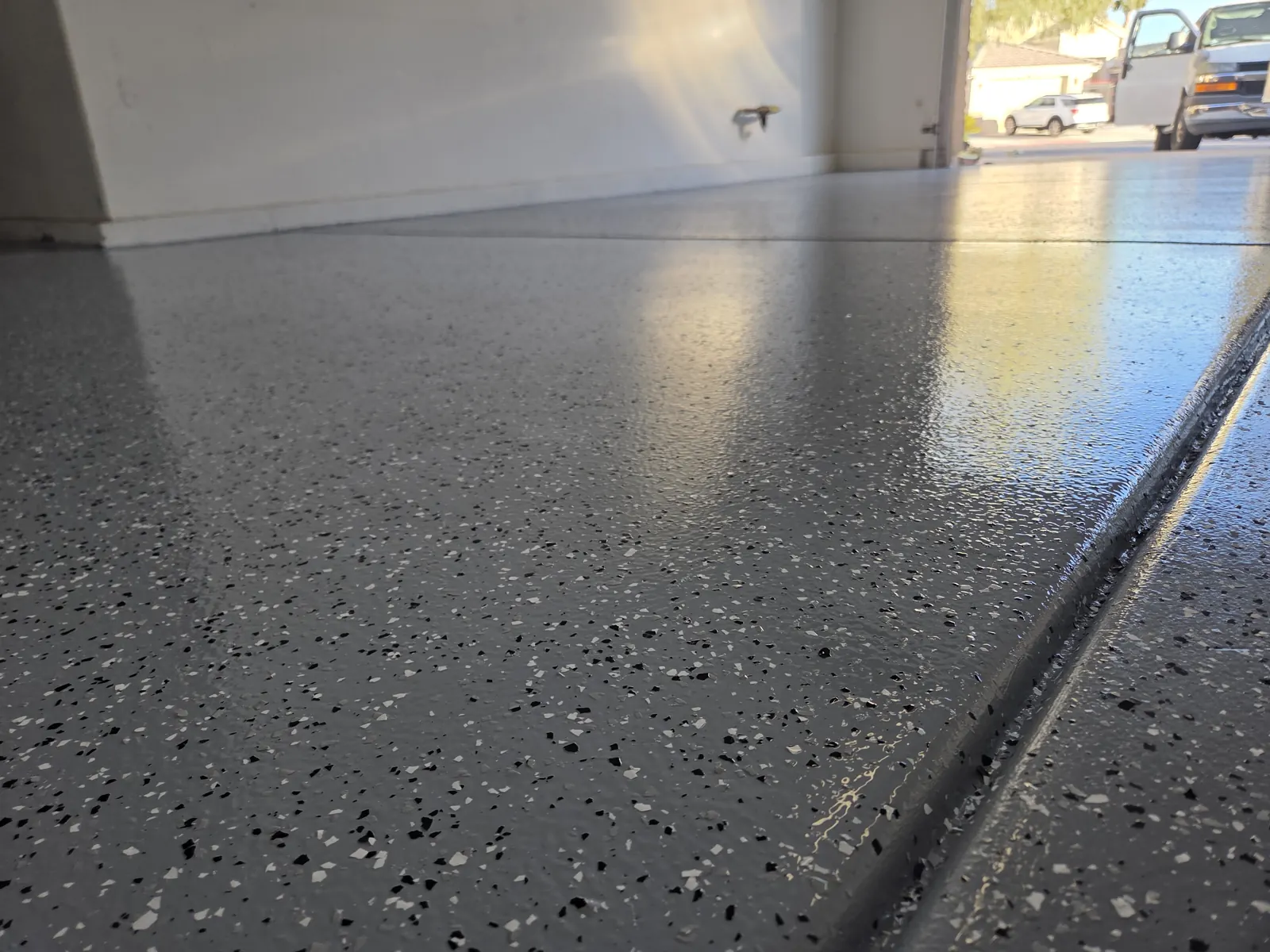
- Full broadcast flake for texture and to hide dust and tire marks.
- A clear UV-stable topcoat to lock in the flake and take the abuse.
That combination gives you the bond and build of a strong base with the sun and wear resistance of a premium topcoat.
What matters more than the label
Honestly, prep matters more than which product is in the can. The most expensive polyaspartic will fail on a slab that was not ground, and a well-installed system on properly prepared concrete will outlast a premium coating installed in a hurry. When you compare quotes, ask how the concrete will be prepared, what the topcoat is, and how cracks will be handled.
"We had over 4000 sq ft of outdoor raw concrete covered with epoxy and polyaspartic coating. Every inch was prepared meticulously." – Peter B., Google review
Ready for a new garage floor?
We will measure your garage, check the concrete, show you flake samples and give you a free written estimate. Call or text (702) 580-9237 or see our garage floor epoxy page.
Frequently asked questions
Which lasts longer, epoxy or polyaspartic?
A floor system with a properly ground slab, a solid base coat and a UV-stable polyaspartic or polyurethane topcoat generally outlasts a single-product floor. The installation matters more than the product name.
Is a one-day garage floor real?
Fast-curing polyaspartic systems can be installed in a day. Whether that is right for your floor depends on the slab condition, crack repair and temperature. We will tell you honestly what your floor needs.
Can polyaspartic be used outdoors?
Yes. Because it is UV stable, polyaspartic is a good choice for patios, pool decks and other outdoor concrete, usually with an anti-slip additive.